
DMYTRO BALKHOVITIN, OKSANA CHORNA, MYROSLAV KOBYLIANSKYI, ANTON SHEVELIOV
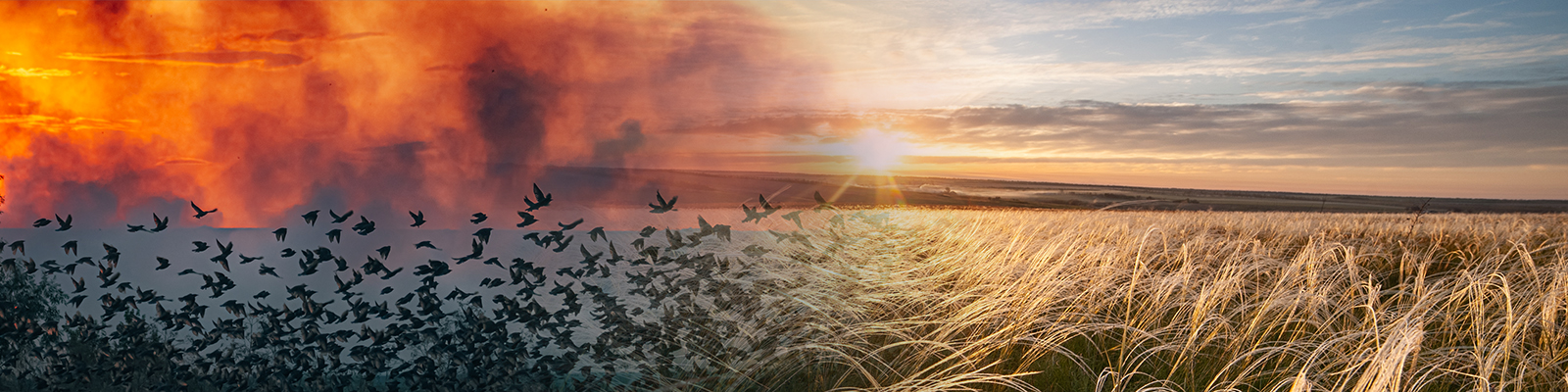
The project not only reminds viewers of what the war-torn Donetsk Oblast looks like today but also gives them a sense of what it was like in peacetime. By contrasting photos of peace and war, the project’s contributors strive to show what could await any region of Ukraine in the absence of unity and unconditional resistance to the aggressor.
The Donetsk region has always been considered purely industrial. Nevertheless, its cities were blooming and green—with beautiful parks and shady boulevards. While it wasn’t a popular tourist destination, it had its unique beauty and potential, distinct from other parts of Ukraine. Amid the densely located cities and villages, fields and forest belts, lie hidden steep ravines and rivers, steppe areas covered in feather grass, oak forests, and the Sea of Azov. The project’s creator, Dmytro Balkhovitin, has been photographing all of this for 15 years. Another contributor to the project, Myroslav Kobylanskyi, captured the peaceful city of Mariupol, the main port of the Nadazovia region, in his photographs.
However, that all changed in 2014, when those lands were among the first to face the aggressor’s onslaught. Russia turned the lush steppes, the Azov coast, and the cities and villages in the Donetsk region into ashes. Now, in the Donetsk steppes, Ukraine’s finest sons and daughters are sacrificing their health and lives for our freedom. Oksana Chorna, Anton Sheveliov, and Myroslav Kobylanskyi have documented this tragic chapter in the history of the Donetsk region in their photographs.
Thanks to the resilience of the Ukrainian Defence Forces, volunteers, and its residents, the Donetsk region has been and will remain Ukraine’s eastern outpost. Many people have lost their homes but not their faith in the prospect of returning and rebuilding. Some will never come back here, while others will find new opportunities and a new life here. This beautiful land faces tragic events not for the first time in its history. But it will be reborn in a new, changed form. And what it will be like depends on all of us.
The concept for the project, To The Hell and Back, was conceived by Dmytro Balkhovitin, a photographer and veteran. Three other photographers and active-duty service members are also contributing to the project: Oksana Chorna, Myroslav Kobylanskyi, and Anton Sheveliov.
Dmytro Balkhovitin (Donetsk) is a landscape photographer. For 15 years prior to Russia’s full-scale invasion, he photographed the Donetsk region. From February 2022 to March 2025, he took part in repelling the Russian aggression as part of the 109th Territorial Defense Brigade. He is a veteran and the author of the book Donetsk Region: around beauty.
Oksana Chorna is the head of public relations for the 23rd Separate Mechanized Brigade and holds the rank of captain. She was involved in combat operations as part of the 28th Separate Mechanized Brigade, serving as a driver-medic from July 2015 to November 2016, and following the start of the full-scale invasion, as part of the 57th Separate Motorized Infantry Brigade, serving as a combat medic, and as part of the 53rd Separate Mechanized Brigade, serving as a press officer. In civilian life, she holds a Ph.D. in Economics and is an associate professor. She is a member of the National Union of Photo Artists of Ukraine.
Myroslav Kobylanskyi (Kolomyia) is an officer in the Armed Forces of Ukraine, a traveler, local historian, and photographer. He is the author of the book My Mariupol and the world around it, as well as several publications on local history.
Anton Sheveliov (Dnipro) is a lieutenant in the 108th Da Vinci Wolves Assault Battalion. He is a traveler, photographer, and co-owner of Hakuna Matata Expeditions.